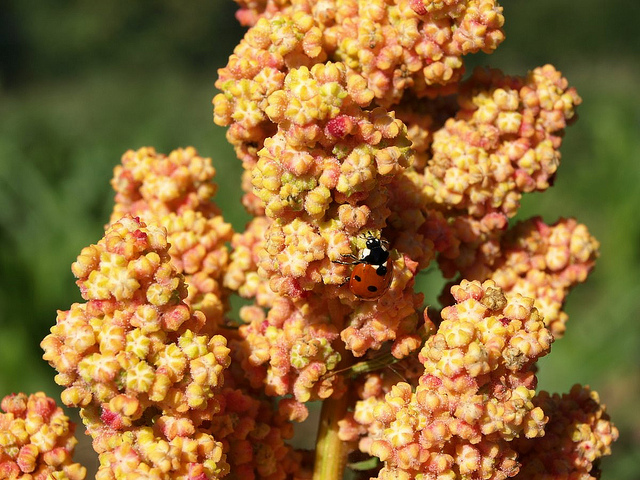
Our patch of six-foot tall willowy candy-coloured quinoa has been one of the surprise stars of OxGrow’s first growing season. The luscious red stalks of our Real Seed Company Rainbow Quinoa were the show-stealer in a strong field (haha) of competition, topping our beautiful heritage wheat and bloody butcher corn in terms of striking visual appeal. After harvest, the crop has proven equally compelling, provoking a few moments of head scratching as we debated the best methods of releasing the grains from their dried hulls and then how to best separate out the accompanying chaff. Add to this a back-story involving Incas and the conquest of the Andes and circulating rumours that it is a super-food being considered by NASA as a staple for long-term space missions, and we’re onto something interesting.
First, the basics. It’s pronounced keen-wah. Some people will claim it is keen-o-ah… I think they’re wrong, but we won’t get hung up on technicalities! It’s a new world crop, first domesticated in the Andes 3-4,000 years ago. Although in culinary terms it occupies the same niche as rice, bulgar wheat and couscous, it’s actually not a true cereal grain but a goosefoot, more closely related to spinach, tumbleweed and the common (edible) weed fat hen. When the conquistadores arrived in quinoa-country, they tried to persuade the Inca people to give up on such ‘Indian food’ and grow wheat instead, a cereal vs. pseudocereal battle that is still raging in the Andes today, although in different form. Nonetheless ‘the mother of all grains’, as it was known, survived and is still widely cultivated in Peru and Bolivia. Not for no reason is quinoa beloved in South America. In particular, it has a much higher protein content than other staples of the region like rice or corn (18% compared to 7% or 3% respectively). And unlike other staples its protein component features a balanced range of amino acids, making it a good replacement for meat proteins in a vegetarian diet. It is high in fibre, phosphorous, magnesium and iron, and it is gluten-free. Not only the quinoa grain itself but also the leaves can be eaten (we didn’t know this when we harvested, but we’ll save some for a quinoa leaf soup next year), and if the grains are germinated by leaving for a few days in cold water, their nutritional properties are magically multiplied as enzymes become active.
Quinoa also comes with its own natural defence against predators – it is naturally imbued with bitter-tasting saponins that prevent birds and beasts from feasting on the plants. Brilliant… but it does add one extra stage to the already long processing that the crop requires before it can be eaten. Good thing we love labour intensive crops! We started off by cutting the stems and leaving to dry inside for a few weeks. Then to extract the grains, a team of volunteers downed shovels and took up a meditative pace of work, rubbing the plant heads through their fingers to leave a mix of grains, chaff and dust. Many methods were piloted to separate out the pure grains from this mixture, including shaking and sieving, but in the end good old-fashioned winnowing in the wind was the only thing that did the trick, letting the lighter chaff fly off into Oxfordshire whilst (hopefully) catching the grains below. From this stage the saponins must be removed by soaking several times before cooking. (Industrially-processed quinoa is often ‘polished’ rather than soaked, literally rubbing off the outer layer of saponins and reducing its nutritional value). Advice from experienced quinoa farmers and chefs much appreciated on how to improve our process! Next on the agenda is cooking it up for our Harvest Festival this Sunday. When boiled, the disk-shaped seeds – which resemble flattened couscous grains – unfurl their crunchy tail-like ‘germ’ and can easily be mistaken for tadpoles. Recipes coming soon.. any good ideas?
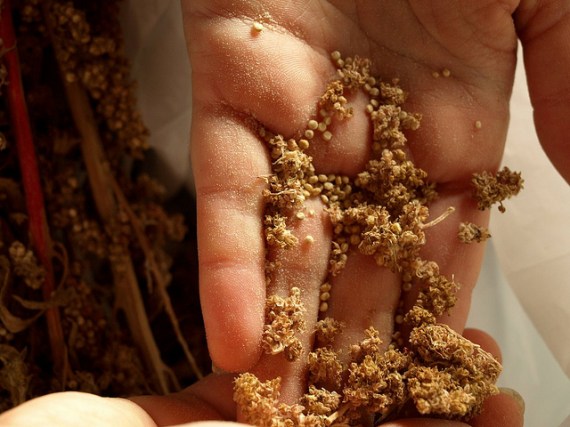
Quinoa and chaff, by hand!
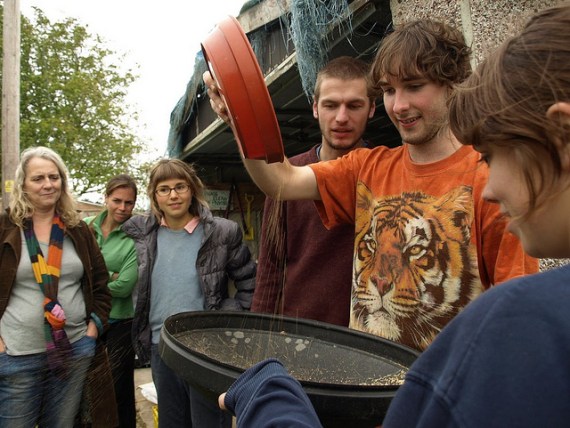
Peter winnows to enraptured audience


 OxGrow